Optimizing Search Engine Spider Behavior meta name=”robots” meta tag resolution


Article Description:
meta name=”robots” is an HTML meta tag designed to provide search engine spiders (i.e., search engine crawlers) with relevant information about a web page.
The name attribute of this meta tag is set to ”robots” to indicate the behavior of search engine spiders. The content attribute defines specific instructions for how the search engine spiders should handle the current page.
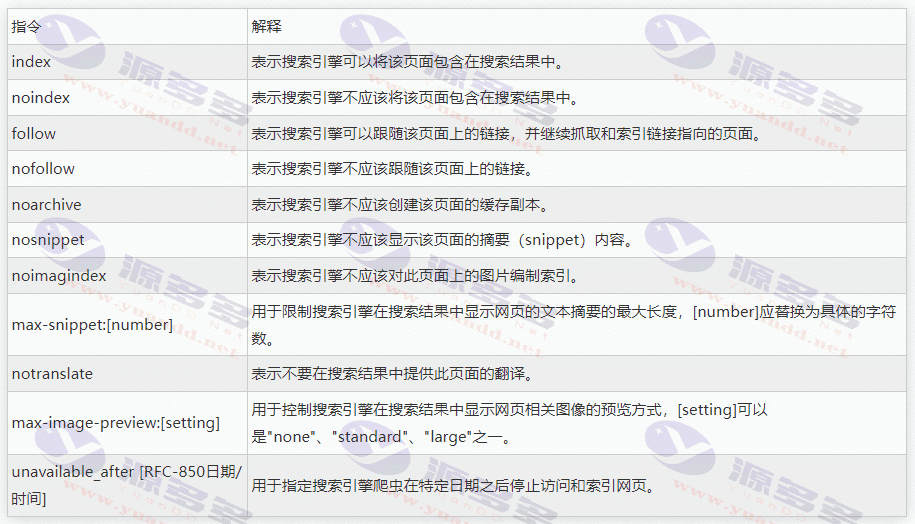
The following are some commonly used commands:
How to use robots meta tags?
As with other tags, the robots meta tag should be placed within the head tag of the HTML page of the web page. An example would be: where the content attribute has the value ”index”, indicating that the search engine should index the current page. Although only an example is provided here, search engines actually index pages by default, and you should specify behavior that should not be performed. If the site contains a large number of pages, it may not be necessary to let the search engine index each page. Sometimes you may want to prevent search engines from indexing a particular page on your site, or you may not want search engines to pass page weight through links. robots meta tags come in handy for telling search engines not to index a particular page or not to crawl links on a particular page. Think of it as a generic directive that applies to all search engine spiders and requires special handling of the page. For example, the above directive tells search engines not to index the current page. It is important to note that there is no restriction on using one directive at a time. A combination of directives can be used, separated by commas. For example: the above directive informs search engines not to index the page and not to follow links to the page or pass page weights. It should not be written this way: these are two completely opposite directives. It should also not be written this way: this is incorrectly formatted and lacks spacers between the directives. max-snippet Example: 150 is the maximum text summary length. Search engines try to reduce the content of a web page to a text summary of no more than 150 characters and display it in the search results. Note that the exact number of characters may vary from search engine to search engine, and some search engines may fine-tune the number of characters to provide a better search experience. Specifying a smaller number controls the length of the text summary, but is not mandatory for all search engines. robots meta tags are important? Is it optional? Many websites do not use the robots meta tag, which has little effect on a website, and search engines will not consider a website to be problematic due to the lack of this tag. If a page does not contain any robots directive, search engines will index the page by default, follow all links and pass on weight, and index all images on the page. Whether it is important or not depends on your needs. It serves certain purposes and helps in SEO optimization of the website, for example, not wanting search engines to index duplicate pages or pages that contain only a small amount of content. Is using robots meta tags good for your website's SEO? If a page uses the index,follow directive, adding or not adding the robots meta tag has no effect on search rankings or other metrics. Therefore, there is no need to obsess about adding this tag to improve your search rankings. Do search engines always follow the instructions in the robots meta tag? Not necessarily. Search engines do not have to follow the directives in the robots meta tag because the tag is only a recommendation. Search engine algorithms and behavior will be optimized and adjusted according to their own strategies. In most cases, search engines will honor your request, but it is not mandatory and results may vary from search engine to search engine. Does adding a robots meta tag to a web page prevent spiders from crawling the web? No. Adding robots meta tags will not prevent search engine spiders from crawling specific pages. Depending on the needs of the site, appropriate directives can be set up to control the indexing and spidering behavior of the page to optimize how the search engine treats and displays the site. Although search engines do not have to follow the directives in the robots meta tag, it is beneficial to use it when needed. Search engines will honor your directives, but the results need to be determined by the search engines themselves, not by you. It is a code of ethics, not a law. Please note: robots.txt and robots meta tag are two different things, don't confuse them. The former is a txt file and the latter is an HTML tag.


- Can free downloads or VIP member-only resources be commercialized directly?
- The resources on this site are collected and organized through the network, for personal research and study purposes only. The copyright belongs to the legal owner of the software and program code, users should verify the copyright and legality of the resources, prohibited for commercial use, illegal activities or any violation of national laws and regulations.
- Disclaimer of liability for program or code bugs, compatibility issues or functional defects, etc.
- As the resources on this site are collected and organized through the network, not the site's original, it can not fully guarantee its functionality or code compatibility. Users need to verify whether the resources meet the needs of their own, due to the following circumstances lead to losses, this site does not assume any responsibility:
Programs, source code and other computer software resources may contain code vulnerabilities (bugs), compatibility issues or functional defects left by the developer. This site does not provide free repair services for such technical defects, users need to bear the risk of debugging, modification or abandonment of the use.